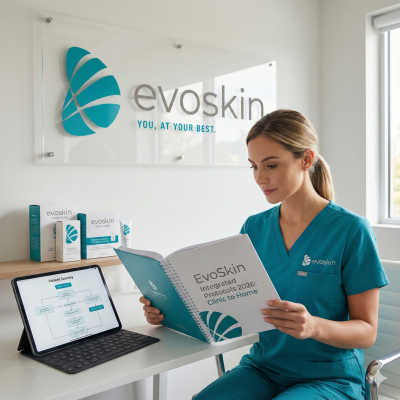
For advanced aesthetic providers, the key differentiator in 2026 is no longer the device alone. It is how treatments are extended beyond the procedure room. High-performing clinics are adopting closed-loop clinical systems where in-office technologies and prescribed homecare operate as a single therapeutic pathway.
EvoSkin’s model is built precisely around this principle: professional devices create controlled biological change, while targeted homecare stabilizes, supports, and amplifies that response between sessions.
This article is designed as a provider-only training resource to help standardize protocol design, patient education, and clinical decision-making.
Energy-based devices initiate collagen remodeling, tissue tightening, and dermal reorganization. However, the quality and durability of results depend on what happens during the weeks that follow.
Without structured homecare support, providers commonly observe:
In 2026, these issues are no longer acceptable variables. Clinics are expected to manage the entire biological cycle, not just the stimulus.
EvoSkin protocols follow a repeatable three-phase logic:
Professional devices initiate:
This phase defines the tissue trajectory.
Post-treatment skin is metabolically active and vulnerable. Proper support:
This phase determines treatment tolerance and early outcome quality.
As collagen remodeling continues over weeks to months, maintenance care:
This phase determines longevity and patient satisfaction.
From a clinical standpoint, relying exclusively on in-office treatments creates:
Integrated protocols allow providers to lower aggressiveness while improving outcomes, which aligns with modern regenerative and low-downtime philosophies.
Mandel Professional is designed for controlled, supervised use within the clinic setting. Its role is corrective and preparatory.
Clinical objectives:
Indications:
Mandel Professional should be positioned as a procedural tool, not a retail product.
Mandel Homecare is not a diluted version of professional treatments. It is formulated for daily biological modulation, where consistency matters more than intensity.
Clinical objectives:
Indications:
Mandel Homecare functions as prescription-level continuation therapy, extending clinic results into the patient’s daily routine.
When paired correctly with EvoSkin devices, Mandel protocols create measurable advantages:
Clinically, this reduces the need for aggressive retreatment and increases predictability across patient populations.
| Timeline | Protocol |
|---|---|
| Session Day | EvoSkin device treatment (collagen activation/tightening) Immediate calming and barrier-support care |
| First 7–14 Days | Mandel Homecare focused on recovery and hydration Strict photoprotection |
| Weeks 3–6 | Continued Mandel Homecare for collagen support Optional Mandel Professional session if indicated |
| Reassessment | Objective evaluation Adjust intensity or maintenance schedule |
This structure creates a repeatable clinical system, not an improvised treatment plan.
From an operational and clinical standpoint, this approach delivers:
Most importantly, it reinforces your role as a medical authority, not a service provider.
In 2026, excellence in aesthetic medicine is defined by:
EvoSkin’s professional devices initiate change. Mandel Professional refines it. Mandel Homecare preserves it. Together, they form a clinically coherent system.
EvoSkin is built around the idea that reproducible outcomes require structured pathways. Integrating professional technologies with clearly defined homecare is no longer optional. It is the standard for modern, regenerative, non-surgical aesthetics.